Why You Still Need a Jacket in Summer - Even on the Hottest Days
It's a temptation every rider has faced: it's 90°F, the pavement is shimmering, and stripping down to a t-shirt sounds like the only rational response.
Biker Jacket protects your skin
The problem is that temperature doesn't change what happens to unprotected skin against asphalt at 50 mph. Road rash is road rash in July as much as January.
The right summer motorcycle jacket makes this a non-negotiation.
Modern summer riding jackets are built around a single purpose:
- Keep air moving,
- Keep armor in place, and
- Keep as much material between you and the road as the heat allows.
The gear has advanced significantly, today's best mesh jackets are dramatically cooler than anything available even a decade ago, and perforated leather has reached a point where many highway riders use it year-round in temperate climates.
The smartest framing for summer riding gear isn't "do I need to wear a jacket" , it's "which jacket handles this temperature best." That's the question this guide answers.
The Three Types of Summer Motorcycle Jacket - Compared
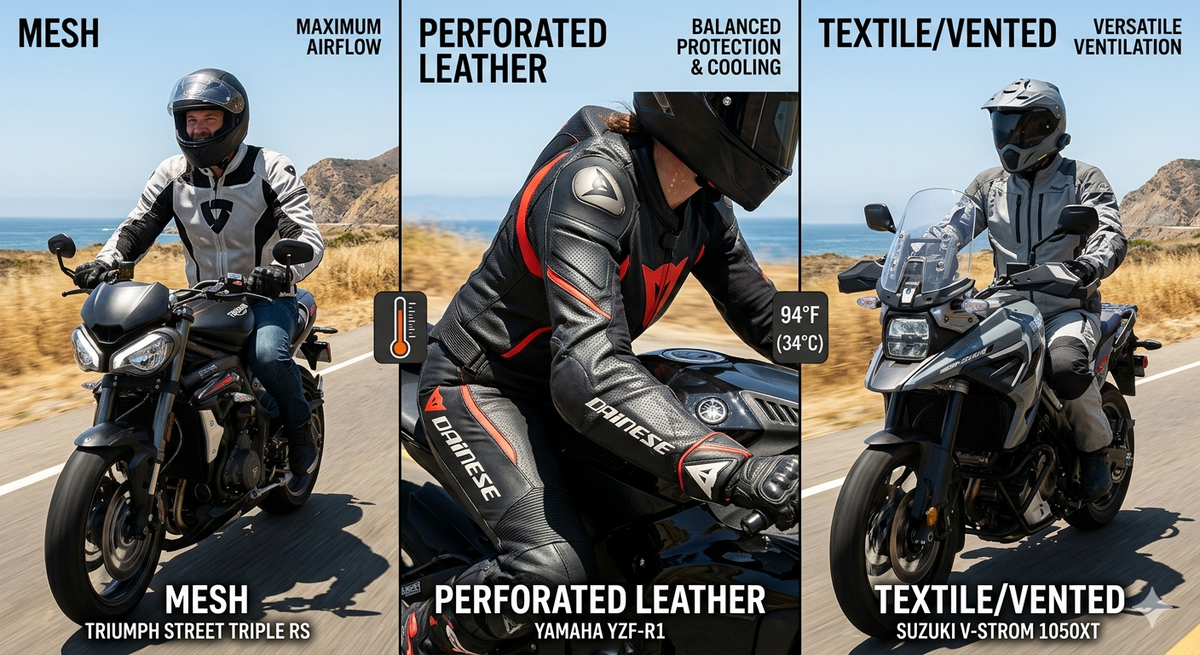
Every summer motorcycle jacket approach falls into one of three camps. Understanding how they perform differently is the prerequisite for choosing correctly.
Mesh Textile Jackets
A mesh motorcycle jacket is engineered around maximum airflow.
Large panels of open-weave textile, often 600D polyester or similar abrasion-resistant fabric, cover the torso, arms, and back, with solid textile reinforced at high-impact zones like the shoulders and elbows.
At speed, air moves through freely. Even at slow speeds, there's significantly more ventilation than any leather alternative.
Check out the limited stock of Vintage Motorcycle Jackets
The tradeoff is slide resistance.
RevZilla notes that while mesh jackets use the same CE-rated shoulder, elbow, and back armor as other jackets, the lightweight mesh panels themselves offer less abrasion resistance than leather in the event of a slide.
At highway speed in a serious crash, leather's edge becomes meaningful.
Mesh is also not waterproof. A sudden summer shower soaks a mesh jacket instantly. Many mesh jackets include a removable waterproof liner, but with the liner in, most of the ventilation benefit disappears. Pack a separate compact rain shell if you use a mesh jacket in changeable weather.
Best for: Urban commuting, extreme heat (above 90°F/32°C), stop-and-go traffic, casual summer rides.
Perforated Leather Jackets
A perforated leather jacket uses genuine leather throughout the construction, but with thousands of small holes punched through the hide in key ventilation zones, typically the chest, back, and upper arms.
At riding speed, air passes through these perforations and creates airflow across the body. The slide resistance of real leather is fully maintained regardless of perforation.
The limitation is at standstills.
Leather doesn't breathe passively the way mesh does, without forward motion to push air through the perforations, a perforated leather jacket traps heat.
Get your hands on the beige fur lined jacket for men
Riders on forums consistently report that perforated leather is manageable at speed up to around 90–95°F (32–35°C) but becomes uncomfortable at extended stops above those temperatures.
For highway riders, sport riders, and anyone who spends most of their time moving rather than stopped, perforated leather is one of the most sensible summer choices available.
According to RevZilla, perforated leather gives riders "the high-level slide protection of leather but with thousands of tiny holes that flow air as you ride", calling it "the best of both worlds for protection and airflow."
Best for: Highway riding, sport riding, moderate heat (up to 90°F/32°C at speed), riders who prioritise protection over maximum airflow.
Ventilated Hybrid Jackets
The hybrid approach combines a leather or textile outer shell with strategically placed mesh panels in the highest-heat zones, the underarms, lower back, and chest.
The result is more airflow than a standard leather jacket and more slide resistance than a full-mesh jacket. Most modern touring and adventure jackets use this construction.
Quality ventilated hybrids also add zippered external vents that can be opened or closed depending on conditions, allowing a single jacket to function across a wider temperature range than either pure mesh or pure leather.
Best for: All-day touring, variable weather, riders who want one jacket across multiple seasons, adventure riding.
The Motorcycle Jacket Material Comparison at a Glance
| Feature |
Mesh Textile |
Perforated Leather |
Ventilated Hybrid |
| Airflow at speed |
⭐⭐⭐⭐⭐ Excellent |
⭐⭐⭐ Good |
⭐⭐⭐⭐ Very Good |
| Airflow when stopped |
⭐⭐⭐⭐⭐ Excellent |
⭐ Poor |
⭐⭐⭐ Moderate |
| Slide resistance |
⭐⭐ Moderate |
⭐⭐⭐⭐⭐ Excellent |
⭐⭐⭐⭐ Very Good |
| Rain protection |
None (liner needed) |
Minimal |
Varies by model |
| Best temperature range |
75°F–110°F+ (24–43°C+) |
55°F–90°F (13–32°C) |
50°F–95°F (10–35°C) |
| Durability |
Moderate |
Excellent (improves with age) |
Good |
What Makes Real Leather a Legitimate Summer Option
The default advice often steers riders away from leather for summer entirely. It's advice that over-simplifies the situation, and it overlooks what real leather, specifically lambskin, actually offers in warm conditions.
Lambskin is the lightest and most breathable of all genuine hides. Unlike cowhide, which is dense and structured, lambskin drapes and allows natural air movement around the body.
Everyone loves lightweight lambskin leather jacket
A lambskin jacket with well-placed venting or perforation doesn't perform like a winter cowhide jacket, it performs more like a lightweight shell that happens to be significantly more abrasion-resistant than textile equivalents of the same weight.
The argument for real leather in summer comes down to protection consistency.
Riding gear's job is protecting you in the event of a crash, and the protection properties of genuine leather don't degrade with heat or repeated washing the way synthetic materials can.
Offers three-layers full protection
A quality lambskin motorcycle jacket bought for summer riding is still protecting you at full capacity three years later in the same heat.
That said, real leather, even perforated lambskin, has a meaningful limitation: stopped traffic in extreme heat.
The most honest framing is this:
"if your summer ride is primarily highway or open road, real leather with good ventilation is a sensible and sustainable choice."
If you're commuting through dense city traffic where you stop every 200 metres, mesh or a lightweight hybrid will serve you better in temperatures above 85°F (29°C).
Five Features to Check in Any Summer Motorcycle Jacket
Before committing to any summer motorcycle jacket, leather, mesh, or hybrid, verify these five things.
1. CE-Certified Armor at Minimum in Shoulders and Elbows
CE Level 1 armor absorbs impact energy to 18kN transmitted force; CE Level 2 performs to 9kN.
Any jacket marketed as protective riding gear should include CE-rated inserts at the shoulder and elbow, with a pocket or included insert for a back protector.
Generic foam padding is not CE armor. Always confirm the certification, not just the presence of padding.
2. Venting That Actually Works
Look for vents that are positioned in high-heat zones, the chest, underarms, and upper back, not just as design details on the front.
A rear exhaust vent paired with front intake vents creates a pressurised airflow system that works significantly better than front vents alone.
If the jacket has adjustable vents (zippered rather than always-open), you get flexibility across temperature ranges.
3. Wrist and Hem Adjustment
Adjustability at the hem and wrists matters in summer because it allows you to control how much air is sealed in versus flowing through.
A snug hem on a mesh jacket creates more airflow pressure through the body of the jacket, while an open hem lets air escape too freely at speed.
Many riders prefer a close hem with maximum ventilation elsewhere.
4. Moisture-Wicking Lining
The lining is a frequently overlooked factor in summer comfort. A heavy polyester or nylon lining traps moisture and becomes sticky in heat.
The best summer jackets use a lightweight, moisture-wicking mesh lining that draws sweat away from the body. This detail makes more difference than most riders expect.
5. Compatibility With Your Base Layer Strategy
The jacket is only one part of the system. Wearing a cotton t-shirt under any summer jacket significantly reduces its effectiveness, cotton absorbs moisture and holds it.
A moisture-wicking polyester or merino wool base layer keeps sweat moving away from your skin, which is what actually keeps you cool.
In extreme heat, a water-activated cooling vest over a base layer and under the jacket adds another layer of temperature management.
The Temperature-Based Decision Framework
Here is the practical guide for matching jacket type to conditions:
-
Below 65°F (18°C): Standard leather jacket or insulated textile. No summer jacket needed.
-
65°F–80°F (18–27°C): Vented leather or hybrid textile. Comfortable range for most materials.
-
80°F–90°F (27–32°C) at highway speed: Perforated leather or vented hybrid. Moving airflow keeps leather manageable. If you stop frequently, switch to a hybrid or mesh.
-
80°F–90°F (27–32°C) in city traffic: Mesh textile or lightweight hybrid. Frequent stops make leather impractical at this temperature in urban environments.
-
Above 90°F (32°C): Quality mesh jacket with CE armor is the most practical option. Add a cooling vest if conditions allow. A perforated leather jacket remains an option for highway-only riding where you maintain speed.
-
Above 100°F (38°C): This is pushing the limit for safe extended riding regardless of gear. If you must ride, choose the most ventilated mesh option available, stay hydrated, and take regular breaks in the shade.
Real Leather Motorcycle Jackets for Summer - What Cuir Offers
Every jacket in the Cuir motorcycle jacket collection is built from 100% genuine leather, cowhide or lambskin depending on the style.
- Lambskin biker and racer styles
For riders who want real leather performance in warm conditions, the lambskin biker and racer styles are the starting point.
Lambskin is meaningfully lighter and more breathable than cowhide, it drapes naturally and creates less resistance to airflow around the body.
The café racer styles are the leanest silhouettes in the range, with a close fit that minimises dead air between the jacket and the body, which is what makes leather feel hot when it's not moving.
- Close-fitting lambskin racer jacket
A close-fitting lambskin racer jacket in summer performs differently than a loose, boxy unvented leather jacket.
The Dean cowhide biker jackets are the more structured option, built for durability and the break-in patina that makes a jacket yours over time.
These are better suited to transitional season riding, spring and fall, than peak summer heat, unless your riding is predominantly at speed on open roads.
For peak summer commuting in warm climates, pair any leather jacket with moisture-wicking base layers and plan routes that keep you moving.
- Genuine leather as primary material
The Cuir range doesn't include dedicated mesh jackets, the collection is built around genuine leather as the primary material.
This is for riders in climates where temperatures regularly exceed 90°F for extended periods.
A quality mesh jacket from a dedicated safety gear brand should supplement rather than replace real leather for those specific riding conditions.
Frequently Asked Questions About Motorcycle Jackets for Summer
Can you wear a leather motorcycle jacket in summer?
Yes, with the right leather jacket.
Perforated or vented leather jackets are designed specifically for warm weather and remain a legitimate summer option, particularly for sport and highway riders.
A perforated lambskin jacket is significantly cooler than an unvented one while retaining leather's superior slide resistance.
The key is choosing a leather jacket with sufficient ventilation and wearing moisture-wicking base layers underneath.
What is the best material for a motorcycle jacket in summer?
For maximum airflow, mesh textile is the coolest option. For the best combination of protection and breathability, particularly for highway or sport riding, perforated leather offers slide resistance that mesh cannot match.
The right choice depends on your riding style and climate: mesh for city commuting in extreme heat, perforated leather for sport or highway riding where protection is the priority.
How hot is too hot to wear a leather motorcycle jacket?
Most experienced riders report that perforated leather remains manageable at moving speed up to around 90–95°F (32–35°C). The challenge is when stopped: leather traps heat at standstills in a way that mesh does not.
Above 95°F in urban riding with frequent stops, a quality mesh jacket with CE armor becomes the more practical choice, with leather reserved for higher-speed riding where airflow is consistent.
Is a mesh motorcycle jacket safe enough?
A quality mesh motorcycle jacket with CE-rated armor is significantly safer than riding without protection.
Modern mesh jackets use 600D polyester or similar abrasion-resistant materials in the outer construction, with the same CE Level 1 or CE Level 2 shoulder, elbow, and back armor as textile or leather jackets.
The main limitation is at very high speeds or in serious crashes, where leather's slide resistance has an edge over lightweight mesh panels.
What should I wear under a motorcycle jacket in summer?
Avoid cotton, it absorbs and holds moisture, making you feel hotter. Wear a moisture-wicking base layer (polyester or merino wool) that draws sweat away from your skin and lets it evaporate.
For extreme heat, a cooling vest worn over a base layer and under the jacket can make a significant difference by lowering skin-adjacent temperature.
A long-sleeve base layer also provides additional UV protection and prevents the jacket lining from rubbing on bare skin.
Does jacket colour affect how hot you get while riding?
Yes, though the effect on the rider's body temperature is more modest than most people assume. Darker colours absorb more solar radiation on the jacket's outer surface, which means the outer shell gets hotter.
However, because air is moving through or around the jacket while riding, much of this surface heat dissipates. Lighter colours are a better choice for slow urban riding or when stopped frequently, as there's less airflow to dissipate absorbed heat.
Can a real leather motorcycle jacket be worn for summer commuting?
A real leather jacket can work for summer commuting with the right setup:
- Choose a perforated or vented lambskin jacket (lighter and more breathable than cowhide),
- Pair it with a moisture-wicking base layer, and if temperatures regularly exceed 90°F with heavy stop-and-go traffic,
- consider a hybrid strategy; leather for the open sections, mesh for the dense urban portions.
- For year-round commuters in moderate climates, a single quality perforated leather jacket is a practical choice.
What is CE armor and why does it matter in a summer motorcycle jacket?
CE armor refers to protective inserts at key impact zones, shoulders, elbows, and optionally the spine and chest, that meet the EN 13595 European safety standard.
CE Level 1 armor absorbs impacts up to 18kN of transmitted force; CE Level 2 reduces this further to 9kN.
Summer motorcycle jackets use the same CE armor grades as winter jackets. Always verify that a summer jacket includes CE-rated armor rather than basic foam padding, which offers significantly less impact protection.
The Bottom Line on Summer Motorcycle Jackets
The best motorcycle jacket for summer is not a single answer, it is the jacket that matches your specific riding conditions to the correct material, construction, and venting approach.
Three principles hold across all choices:
- Never ride without CE-rated armor regardless of temperature,
- Ditch cotton base layers for moisture-wicking fabrics, and
- Match the jacket to how you actually ride rather than an idealised version of it.
A perforated leather jacket on a highway commuter in moderate heat is a smarter choice than a mesh jacket that gets worn reluctantly.
A mesh jacket in urban stop-and-go above 90°F is a smarter choice than leather that becomes miserable at every red light.
If your priority is genuine leather, the material that has been the standard in motorcycle protection for a century, the Cuir motorcycle jacket collection is built around 100% lambskin and cowhide constructions that offer the breathability and durability real leather provides.
Start there, layer correctly, and summer riding becomes what it should be: the best riding of the year.





Leave a comment
This site is protected by hCaptcha and the hCaptcha Privacy Policy and Terms of Service apply.