
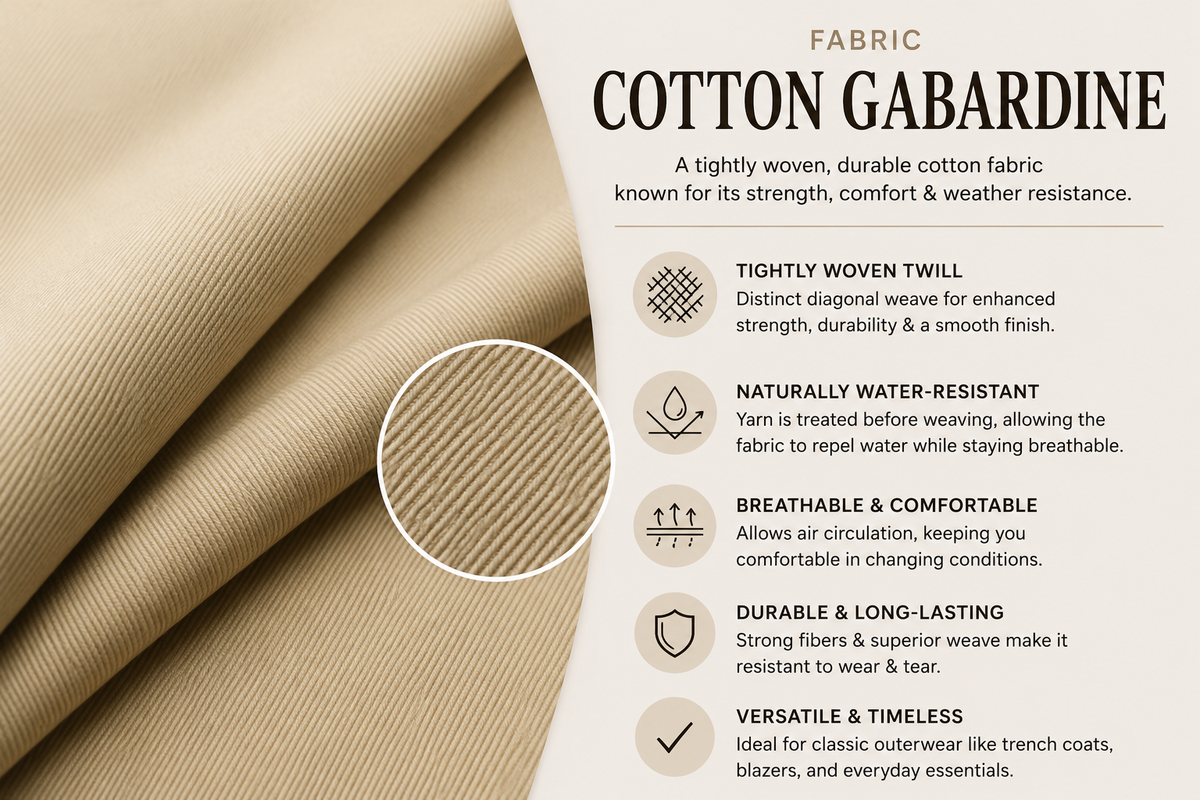
A cotton gabardine trench coat is a trench coat made from cotton gabardine, a tightly woven twill fabric patented by Thomas Burberry in 1879. Gabardine is a weave, not a fibre:
its steep diagonal twill structure creates a dense surface that repels light rain while remaining breathable.
It is the original and traditional trench coat material. It is not waterproof. And for buyers who want a trench coat that lasts a decade and looks better for it, real leather is the more durable long-term answer.
- Gabardine is a weave construction, not a specific fibre - it can be made from cotton, wool, polyester, or blends. Cotton gabardine is the classic trench coat standard.
- Thomas Burberry patented the gabardine weave in 1879, registering it as a trademarked cloth in 1901. It became the WWI officer trench coat material.
- Cotton gabardine is water resistant, not waterproof - it handles light rain through weave density but saturates in sustained downpours.
- Most modern cotton gabardine trench coats add a DWR (Durable Water Repellent) coating that degrades with washing and must be periodically reactivated or re-applied.
- A serious cotton gabardine trench coat uses 8oz cloth or heavier - most mass-market trench coats use 4–6oz which is too thin to perform correctly.
- Leather trench coats provide natural passive water resistance from the hide itself, which improves with conditioning over time rather than degrading with washing.
What Is Gabardine? The Weave That Made the Trench Coat Possible
Most people who own a gabardine trench coat cannot tell you what gabardine actually is. The answer is more specific, and more interesting, than most buyers realise.
Gabardine is a weave, not a fibre. A gabardine fabric is a tightly woven material with a unique twill weave.
One side has fine diagonal ribs, and the other side is smooth. Wool, cotton, polyester, or a mix of these fibres can be used to make it.

What makes gabardine gabardine is the structure of the weave, specifically, the steep diagonal twill that uses significantly more warp threads than weft threads, producing a dense, hard surface with a pronounced diagonal rib visible on the face of the cloth.
Gabardine is a weave, not a fibre. It can be made from cotton, wool, or a blend, but the structure is what defines it: a tight, steep twill with many more warp threads than weft, producing a smooth, hard-wearing surface with a pronounced diagonal rib.

The consequence of this structure is a fabric surface dense enough to shed water without being coated, lined, or laminated.
Water sits on the surface of gabardine and rolls off rather than soaking through the weave, the same way a tightly woven canvas repels rain better than a loosely woven one.
This property is what Thomas Burberry recognised and patented in 1879, and it is what created the modern trench coat as a weatherproof outerwear silhouette.
Thomas Burberry and the 1879 Patent: How Gabardine Became the Trench Coat Fabric
The Origins of the Cotton Gabardine Trench Coat
-
Invented by Thomas Burberry in 1879, cotton gabardine revolutionized weatherproof clothing.
-
Unlike traditional waterproof fabrics of the time, gabardine was:
-
Water-resistant
-
Breathable
-
Comfortable to wear
-
Lightweight and durable
-
What Made Gabardine Different?
-
Burberry's breakthrough was treating the yarn before weaving, rather than coating the finished fabric.
-
This method:
-
Embedded weather resistance into every fiber
-
Preserved the natural breathability of cotton
-
Prevented the waterproofing from wearing off quickly
-
-
The fabric was patented in 1879 and further refined into a registered cloth by 1901.
Military Origins of the Trench Coat
-
During World War I, the British Army required weatherproof outerwear for commissioned officers.
-
Burberry's gabardine became the preferred material because it:
-
Repelled rain effectively
-
Allowed freedom of movement
-
Remained lighter than alternative waterproof fabrics
-
Functional Features Designed for Combat
The classic trench coat was built for practical military use and included:
-
Double-breasted front for added protection from wind and rain
-
Belted waist for a secure fit
-
Storm flap to improve weather resistance
-
Epaulettes for military insignia and equipment
-
D-ring belt for attaching field gear
Lasting Legacy
-
Originally designed for battlefield conditions, the trench coat quickly became a civilian fashion staple.
-
Its combination of:
-
Weather protection
-
Timeless style
-
Functional design
-
Historical significance
has made it one of the most iconic outerwear garments ever created.
-
-
More than a century later, the signature details of the original military trench coat remain hallmarks of authentic trench coat construction.
How Cotton Gabardine Actually Handles Rain — What It Does Well and Where It Stops
Understanding what cotton gabardine genuinely delivers in wet weather, and what it does not, is the most practically useful thing a trench coat buyer can know before spending money.

What Cotton Gabardine Does Well
Water Resistance: The tight twill weave creates a natural barrier against light to moderate rain.
Breathability: Unlike synthetic waterproof materials, cotton gabardine allows air circulation, preventing the clammy feeling associated with plastic-based fabrics.
Durability: High-quality cotton gabardine ages beautifully, developing character over time while maintaining structural integrity for decades.
These three properties, rain resistance, breathability, and longevity, are what made gabardine the right specification for the original trench coat and what keep it relevant as a trench coat fabric today.
In a temperate urban climate with frequent drizzle and light showers, a quality cotton gabardine trench coat does exactly what a trench coat should do.
Where Cotton Gabardine Falls Short
While naturally water-resistant, cotton gabardine isn't waterproof and will eventually soak through in heavy, prolonged rain.
It requires dry cleaning and may wrinkle more readily than synthetic alternatives.
Premium cotton gabardine commands higher prices, reflecting quality and heritage.
The saturation point is the critical limitation. In a sustained downpour, sustained meaning more than 15–20 minutes of continuous moderate-to-heavy rain, a cotton gabardine trench coat without DWR treatment will absorb moisture through the weave.
Once saturated, the coat becomes heavy, loses its insulating properties, and takes time to dry properly.
The other limitation is the DWR dependency of most modern gabardine trench coats. Genuine Burberry-heritage gabardine treated the yarn before weaving, creating intrinsic water resistance.

Shop for full grain leather women's long coat
Most contemporary cotton gabardine trench coats use a surface DWR coating applied to the finished fabric instead, cheaper to produce, but it washes out.
After several washing cycles, a DWR-coated gabardine trench coat that was initially water-resistant may lose much of that performance unless the DWR is reactivated with heat or re-applied.
The Weight Question: Why 8oz Matters More Than You Think
Fabric weight in cotton gabardine is measured in ounces per square yard (oz) and is one of the most reliable indicators of a trench coat's quality and performance.
This is a detail almost no brand marketing communicates clearly, but it makes a significant practical difference.
Most contemporary 'trench coats' use cotton in the 4–6oz range, light enough for spring, but too thin to do the work the design implies.
A serious trench coat uses 8oz cloth or heavier. It hangs properly, blocks wind, and survives a decade of wet commutes.
Difference between a 4oz and an 8oz
The difference between a 4oz and an 8oz cotton gabardine trench coat is not subtle in person.
A 4oz coat is light enough to fold into a bag, but it does not hang with the structured drape the trench coat silhouette requires. It blows and shifts in wind rather than sitting on the body with weight and presence.
An 8oz coat moves the way a trench coat is supposed to move, with authority. The heavier cloth also provides meaningfully better wind resistance, which is a significant part of what makes a trench coat practically weatherproof rather than just rain-resistant.
When assessing a cotton gabardine trench coat: hold the cloth to the light. A proper gabardine is opaque, with a clean, even diagonal grain.
Press a damp cloth against it briefly, water should bead, not soak. Crease it sharply in your hand. It should remember the line, then release it. Cheap gabardine fails all three tests.
Cotton Gabardine vs Wool Gabardine vs Synthetic, The Material Spectrum
The gabardine weave can be executed in multiple fibres, and each produces a meaningfully different result. Understanding the spectrum helps explain why trench coat prices and properties vary so significantly across what are all described as "gabardine" products.
| Material | Water Resistance | Breathability | Warmth | Care | Best For |
|---|---|---|---|---|---|
| Cotton Gabardine | ⭐⭐⭐ Light-moderate rain | ⭐⭐⭐⭐⭐ Excellent | ⭐⭐ Light insulation | Machine wash 40°C | Spring/autumn, urban use, classic look |
| Wool Gabardine | ⭐⭐⭐ Light rain + wind | ⭐⭐⭐⭐ Good | ⭐⭐⭐⭐ Warm | Dry clean only | Winter, formal, premium/bespoke |
| Synthetic / Polyester Blend | ⭐⭐⭐⭐ Good with DWR | ⭐⭐ Limited | ⭐⭐ Light | Machine wash | Budget, travel, casual use |
| Genuine Leather | ⭐⭐⭐⭐ Natural + improvable | ⭐⭐⭐ Moderate | ⭐⭐⭐ Good wind block | Condition + specialist clean | Daily wear, longevity, character development |
Wool gabardine was used on early trench coats as the dense weave repelled water. Fashionably finished with silk linings, these coats were lightweight, functional and handsome. Initially sold only to British officers — who possessed considerable spending power — today, wool gabardine is only used upon request for high-end or custom trench coats. Trench coats made from gabardine are impractical for mass sale because of their high costs.
Cotton Gabardine Trench Coat vs Leather Trench Coat - The Honest Comparison

This comparison is worth addressing directly, because the two materials are frequently positioned as competitors when they are more accurately alternatives serving different buyers with different priorities.
Where Cotton Gabardine Has the Advantage
Cotton gabardine is significantly lighter than leather, a meaningful advantage in a full-length or mid-length trench coat worn daily. It is breathable in a way leather is not, making it more comfortable in temperatures above 15°C (59°F).
It is easier to care for: machine washable in most cases, easy to press and maintain, and available at every price point from fast fashion to bespoke.
For a formal or business context where the trench coat is worn over a suit, the gabardine trench coat reads as the more appropriate and traditional choice.
It is the design that Burberry built, that Humphrey Bogart wore, and that remains the reference point for what a trench coat is supposed to look like.
Where Leather Has the Advantage
Leather trench coats are heavier and warmer than trench coats made from cotton or woollen fabric. Leather repels dirt and water and is easier to clean, which is why these are so popular.
The longevity gap is the most significant practical difference.
A quality cotton gabardine trench coat, well maintained, lasts five to eight years before showing significant fabric wear — fading, loss of structure, thinning at high-contact points. A quality leather trench coat lasts a decade or more and looks better at year five than it did at purchase, because the hide develops a patina that reads as character rather than wear.
The water resistance of a leather trench coat also behaves differently from a gabardine one: conditioning with leather wax improves and strengthens the hide's passive rain resistance over time, rather than degrading as DWR does with washing.
For buyers who want one trench coat for the next ten years, a piece that becomes more personally theirs the longer they wear it, leather is the better material investment.
For buyers who want the classic heritage look in a lighter, more versatile piece for transitional weather, a quality 8oz cotton gabardine trench coat is the correct choice.
The Cuir leather trench coat collection is built for the first buyer, handmade genuine leather, natural water resistance from the hide, a silhouette built on the same classic trench coat design DNA as cotton gabardine, and a price point that reflects the longevity of the material rather than the cost of fabric alone.
How to Care for a Cotton Gabardine Trench Coat
Cotton gabardine trench coats are significantly easier to care for than leather alternatives. The care routine is straightforward but has a few non-obvious details worth knowing.
Washing
Cotton or mixed fibre gabardine: washing machine at 40°C on a delicate programme. Do not tumble dry on high heat, high heat can shrink the cotton fibres and distort the structured silhouette of a tailored trench coat. Air dry on a wide hanger to preserve the shoulder and body shape.
Restoring Water Resistance After Washing
If the trench coat has lost its water-beading ability after washing, test by sprinkling water on the outer surface; it should bead and roll off rather than soaking in, tumble dry on low heat for 20 minutes.
Heat reactivates the DWR polymer chains that washing flattens. If low-heat tumble drying does not restore beading, apply a spray-on DWR treatment (Nikwax TX.Direct or Grangers Clothing Reproofer are both effective) following the product instructions.
Pressing and Wrinkle Care
Cotton gabardine can wrinkle in sustained compression, folded in a bag or stored compressed.
Iron on a medium cotton setting with a pressing cloth between the iron and the fabric surface to avoid flattening the diagonal rib of the gabardine weave.
A garment steamer is an effective alternative that is gentler on the structure.
Storage
Store on a wide shoulder hanger in a breathable garment bag — never folded or compressed, and never in a sealed plastic bag.
Plastic traps moisture and can cause mildew in a stored cotton garment. Cool, dry space away from direct sunlight, which can fade and yellow cotton over time.
Frequently Asked Questions About Cotton Gabardine Trench Coats
What is a cotton gabardine trench coat?
A cotton gabardine trench coat is a trench coat made from cotton gabardine, a tightly woven twill fabric patented by Thomas Burberry in 1879. Gabardine is a weave, not a fibre: the tight diagonal twill structure creates a dense, smooth surface that naturally resists water and wind while remaining breathable.
Cotton gabardine was the original material of the military trench coat issued to Allied officers in World War I and remains the traditional choice for the classic trench coat silhouette.
What is gabardine fabric and how is it made?
Gabardine is a tightly woven twill fabric with a steep diagonal rib on one side and a smooth reverse. It uses significantly more warp threads than weft threads, producing a dense surface that sheds water through weave tightness rather than coating.
Cotton gabardine uses natural cotton fibre in this weave. Burberry's original innovation was waterproofing the cotton yarn before weaving rather than treating the finished cloth, producing superior weather resistance while keeping the fabric breathable.
Is a cotton gabardine trench coat waterproof?
No — cotton gabardine is water resistant, not waterproof.
The tight twill weave sheds light rain and drizzle but saturates in sustained heavy rain. Most modern cotton gabardine trench coats also receive a DWR (Durable Water Repellent) coating to improve rain performance.
DWR causes water to bead and roll off the surface but degrades with washing and wear, it needs reactivating with heat or re-applying periodically. For full waterproofing, a polyurethane membrane with taped seams is required.
What weight of cotton gabardine is best for a trench coat?
8oz or heavier. Most mass-market trench coats use cotton in the 4–6oz range — light enough for spring but too thin to hang, block wind, or survive sustained wet weather correctly.
A serious cotton gabardine trench coat uses 8oz or heavier: it hangs with the correct drape, resists wind, and lasts a decade of regular wear.
Test quality by holding the cloth to light, it should be opaque with a clean diagonal grain, and pressing a damp cloth against it briefly, where water should bead rather than soak.
What is the difference between cotton gabardine and wool gabardine for a trench coat?
Both use the same tight twill gabardine weave but different fibres. Cotton gabardine is lighter, more breathable, and better for spring/autumn wear.
Wool gabardine is warmer, with better insulating properties and a heavier drape, the correct choice for a winter trench coat.
Wool gabardine was used on the earliest trench coats and is now considered a premium or bespoke option due to higher cost. Cotton gabardine is the standard material for most quality trench coats today.
How do you care for a cotton gabardine trench coat?
Machine wash at 40°C on a delicate programme. Do not tumble dry on high heat, air dry on a wide hanger.
If water resistance has degraded, tumble dry on low heat to reactivate the DWR, or re-apply a spray-on DWR treatment. Iron on medium cotton setting with a pressing cloth. Store on a wide hanger in a breathable bag away from direct sunlight.
Is leather or cotton gabardine better for a trench coat?
They serve different purposes. Cotton gabardine is lighter, more breathable, easier to care for, and the traditional trench coat material, correct for a formal aesthetic and moderate transitional weather.
Leather is heavier, more durable long-term, and has natural water resistance from the hide that improves with conditioning rather than degrading with washing.
Leather trench coats develop a patina and improve over a decade of use. For style longevity and material investment, leather. For the classic traditional trench look, quality 8oz cotton gabardine.
Who invented gabardine fabric?
Thomas Burberry invented gabardine in 1879, patenting the weave construction and registering it as a trademarked cloth in 1901.
His innovation was treating the cotton yarn with weatherproofing before weaving the cloth, creating intrinsic water resistance throughout the fabric rather than a surface coating.
The fabric was adopted by the British Army for WWI officer trench coats, directly creating the modern trench coat silhouette that has remained largely unchanged for over a century.



Leave a comment
This site is protected by hCaptcha and the hCaptcha Privacy Policy and Terms of Service apply.